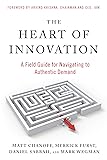
# The Heart of Innovation
**Matt Chanoff, Merrick Furst, Daniel Sabbah, Mark Wegman, and Arvind Krishna** | [[Strategy]]
---
> "Innovations don't succeed just by solving problems. They succeed by solving problems in a way that also solves the problem of why customers haven't already solved the problem themselves."
Most innovation fails because it solves stated problems without addressing why those problems persist. If customers could have solved it, they would have. The real innovation happens when you remove the barriers that kept them from acting—not when you build features.
**Authentic demand** is not "customers will do X because of Y." It's when *not buying* feels like a violation. ATMs didn't succeed because "customers wanted convenience"—they succeeded because once people experienced banking outside office hours, the old way became intolerable. That's authentic demand: a real not-not.
The book demolishes the positive value proposition model ("Customers will buy because they are [type of person]") and replaces it with situation modelling: people are actors in situations, not bundles of properties. You cannot predict behaviour from demographics or stated preferences. You predict it from the situations people find themselves in.
---
## Core Ideas
### [[Authentic Demand]]
Authentic demand occurs when buying is not a conscious choice, but something people do naturally because *not buying* feels like a problem they can't ignore.
It's not "solving customers' problems"—it's exposing unmet demands that people couldn't articulate. It's not "product/market fit" (which is often post hoc rationalisation)—it's creating a situation where not acting becomes intolerable. Examples: ATMs (freedom from bank hours), Google Search (instant, reliable answers), Uber (reliable ride availability).
> "Authentic demand is the demand of people who find themselves in a situation where buying and using a product or service is just a thing they do as part of living their lives."
The test: does the innovation solve not just the problem, but also **why customers haven't already solved it themselves**?
### [[Formative Innovation]]
Formative innovation works by reorganising perception and inserting something (often a product) that exposes unmet authentic demands and frees people to act. This isn't incremental improvement—it's changing the frame so that the old way looks broken.
Before ATMs: "Banks are only open during business hours" (accepted constraint). After ATMs: "Why would I ever wait for business hours?" (reframed expectation).
Formative innovation reorganises perception, then provides the tool to act on the new frame.
### [[Situation Modelling]]
The positive value proposition model fails: "Customers will do X because of Y" or "Customers have property Z, so they'll buy."
Why it fails: people are **actors in situations**, not bundles of properties. You cannot reliably predict behaviour from demographics or traits. "Penny pincher" or "tech enthusiast" tells you almost nothing about whether someone will buy.
> "People are actors; they're not bundles of properties. The most reliable predictor of behaviour is the customer's situation."
A gym assumes "low prices" will attract "budget-conscious customers." But many still don't sign up—not because of price, but because their **situation** (time constraints, self-confidence, commuting patterns) makes the gym irrelevant.
The way to innovate: **model the situation**, not the customer segment.
### [[Resistance to Transformative Change]]
When transformations require people to do their jobs differently, they often respond with an **immune response**—subtly fighting off the change so it never takes root.
Resistance can be explicit (overt pushback), anxious (discomfort and hesitation), or unconscious (barely noticeable, even to the resister).
> "When transformations require people to do their jobs differently, they often respond with a kind of immune response, fighting off the change in subtle and hidden ways so that the transformation never takes root."
Electronic health records (EHRs) promised efficiency but required clinicians to document differently. Many resisted, slowing or killing adoption—not because EHRs were bad, but because they disrupted established workflows.
Innovation inside organisations must account for this immune response, not ignore it.
---
## Key Insights
**The standard value proposition structure doesn't connect with the real world.** People don't buy because they have a property (e.g., "cheap") that matches a product property. "They're not doing X [buying] because we didn't do Y" is usually a post hoc excuse, not a causal explanation. The positive model is enchanting but unreliable.
**Each person's perceptual and conceptual world (their umwelt) constrains what innovators can see.** Four traps:
The curse of knowledge assumes customers know what you know. Early PCs were built by engineers who forgot average users didn't understand command lines.
The lure of features leads to adding bells and whistles rather than solving the underlying situation. Bloated enterprise software with endless features few people use.
Fundamental attribution bias blames customer "traits" instead of recognising situational constraints. Assuming people are "lazy" about saving money, rather than noticing banks make saving hard.
Confirmation bias overvalues data that supports your idea, ignoring signals of indifference.
**Authentic demand means not buying feels like a violation**—something you can't be indifferent to. Marketers are usually too late; true innovation happens at the very beginning. Without understanding authentic demand, "product/market fit" is indistinguishable from hope or rationalisation.
> "Without an understanding of authentic demand, product/market fit is indistinguishable from prior hopes or post hoc rationalisations."
**The way people talk about their problems isn't their actual problems**—it describes how they **conceptualise** their problems. Discerning the gap between how a person sees their situation and how it looks from outside opens a window onto authentic demand.
**If you ask anyone in any business role what they could do to save money, they'll give you a list—of things they're not doing.** People are indifferent to most innovations; the crucial test is whether they're **not** indifferent. Successful innovation must connect with the deep selves—motivations, pride, validation, ambition—of the people it's intended for.
> "The deepest gladness of innovators is to make and do things that make a difference."
---
## Connects To
- [[Obviously Awesome]] - Both emphasise situational context over abstract positioning; customers buy in situations, not in the abstract
- [[Alchemy]] - Reframing perception (formative innovation) parallels Sutherland's insight that perceived value ≠ intrinsic properties
- [[7 Powers]] - Authentic demand creates a moat; once customers experience the new way, the old way becomes intolerable (switching costs)
- [[Playing to Win]] - Situation modelling aligns with "Where to Play": understanding customer context determines strategic choices
- [[Better, Simpler Strategy]] - Simplify to the real question: What is the customer's situation, and what are they actually trying to do?
---
## Final Thought
Innovations don't succeed by solving stated problems. They succeed by solving the problem of why customers haven't already solved the problem themselves.
Most innovation fails because it chases abstract "value propositions" or builds features customers claim to want. But people don't buy because they match a demographic profile or because a product has a property. They buy when their **situation** makes not buying intolerable.
The reframe from customer properties to customer situations changes everything. You cannot predict behaviour from "penny pincher" or "early adopter." You predict it from the situation they're in. A gym membership isn't rejected because someone is "cheap"—it's rejected because their situation (time, location, confidence) makes the gym irrelevant to their actual life.
Formative innovation works by reorganising perception. ATMs didn't just add convenience; they made banking-only-during-business-hours look absurd. Google Search didn't just improve search; it made tolerating bad search engines impossible. The innovation changes the frame, then provides the tool to act on the new frame.
And the uncomfortable bit: transformative innovation triggers an immune response, both in customers and inside organisations. People resist changes that disrupt how they work or see themselves. Ignoring this resistance kills innovation faster than bad ideas.
Stop chasing value propositions. Start looking for authentic demand—situations where not buying feels like a violation.