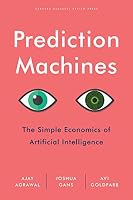
# Prediction Machines
**Ajay Agrawal, Joshua Gans & Avi Goldfarb** | [[Numbers]]
---
> "The new wave of artificial intelligence does not actually bring us intelligence but instead a critical component of intelligence—prediction."
Stop thinking about AI as "intelligence" or "thinking" or "understanding." Think of it as **cheap prediction**. Just as computers made arithmetic cheap, and the internet made distribution cheap, machine learning makes prediction cheap.
And when something gets cheap, we use more of it. We use it in new places. We build entirely new applications around it. The rise of prediction machines creates strategic opportunities and competitive threats—but only if you understand what prediction actually is (filling in missing information) and what it isn't (a decision).
The economic lens matters because it clarifies where AI fits into decision-making: **prediction is an input, not an output**. Humans still supply judgment (defining payoffs) and action (executing decisions). Cheaper prediction makes judgment *more valuable*, not less, because better prediction creates more decision points.
---
## Core Frameworks
### [[AI as Prediction]] – Filling in missing information
**Prediction = using data you have to generate data you don't have.** Machine learning reframes problems from rules-based logic ("What features define a cat?") to prediction problems ("Does this image look like the cats I've seen before?").
Autonomous vehicles don't "think"—they predict what objects are likely to be (pedestrian, sign, shadow) based on training data. This distinction clarifies both the power and limits of AI.
### [[Economics of Cheap Prediction]] – When costs fall, usage rises
As prediction costs drop, we'll see more prediction (existing use cases get cheaper), new applications (prediction in surprising places), and rising value of complements (data, judgment, integration).
**Data is a complement**: more and better data increases prediction quality, which raises its value further. This creates compounding advantages for firms with proprietary data. Amazon's recommendation engine improves as more users buy more products. Autonomous vehicle systems get better as fleets log more miles.
Prediction machines scale: marginal cost per prediction approaches zero, unlike human prediction.
### [[Prediction vs Judgment]] – Inputs and outputs of decision-making
**Prediction** reduces uncertainty by filling in missing information. **Judgment** assigns value to possible outcomes—determining payoffs, utility, rewards, or profit. A prediction is not a decision. Making a decision requires **applying judgment to a prediction, then acting**.
A medical AI predicts 95% confidence a tumour is malignant. The **doctor's judgment** decides whether to operate, monitor, or treat differently based on patient history, risk tolerance, and treatment outcomes.
### [[Strategic Questions for AI]] – Investment theses for leaders
How fast and how far will prediction costs fall in your sector and applications? What strategic options arise if prediction becomes near-free? What complementary investments become critical? (Data, workflows, judgment capacity)
---
## Key Insights
**Algorithmic problems have transformed into prediction problems.** Many tasks have shifted from "What are the features of a cat?" to "Does this unlabelled image match the cats I've seen?" Machine learning uses probabilistic models to solve problems—it's pattern-matching at scale, not reasoning.
**Complements become more valuable as prediction gets cheaper.** Data leads to better predictions. Workflows turn predictions into decisions—systems that channel AI outputs into meaningful actions. Judgment capacity creates more opportunities for assigning value when you face more decisions.
**The unit cost per prediction falls as frequency increases.** Prediction machines scale in ways human prediction doesn't. This creates winner-take-most dynamics: firms that can gather more data and make more predictions compound their advantage.
**Firms that own or control unique data will enjoy compounding advantages.** Data is the raw material; prediction machines are the factory. If prediction costs approach zero, what becomes possible? What business models emerge? What constraints disappear?
Airlines can adjust overbooking policies in real-time if AI predicts no-shows accurately, improving profitability without alienating customers.
**Cheaper prediction doesn't replace judgment—it increases the demand for judgment.** With more (and finer-grained) predictions, you face more decisions. Each decision requires human judgment to weigh payoffs, risks, and trade-offs. Prediction tells you *what's likely*. Judgment tells you *what to do about it*.
**Leaders must design systems that channel AI outputs into actions.** More prediction means more decisions. This isn't just technical integration—it's organisational design: who decides? Based on what criteria? With what authority? The value of judgmental roles (strategists, policymakers, clinicians, risk managers) will rise, not fall.
---
## Connects To
- [[Everything Is Predictable]] – Tom Chivers on Bayesian reasoning complements the economic framing here
- [[Algorithms to Live By]] – Brian Christian on computational thinking and decision-making under uncertainty
- [[7 Powers]] – Hamilton Helmer's framework on scale economies and network effects helps explain compounding data advantages
- [[How Finance Works]] – Mihir Desai on capital allocation pairs with this book's insights on judgment
---
## Final Thought
This book strips away the hype and gives you an economic lens on AI. The reframe—AI as cheap prediction, not intelligence—is clarifying. It tells you where to look for strategic advantage (unique data, integrated workflows, judgment capacity) and what questions to ask (how far will costs fall? what becomes possible?).
**Data as a complement** creates compounding advantages. As prediction gets cheaper, data gets more valuable. And not just any data—**proprietary data** that creates compounding advantages. The firms that control unique data flows will dominate their categories.
Prediction machines change where human effort is best deployed. Less in guessing outcomes (AI can do that faster and cheaper). More in defining values and consequences (only humans can do that). The future of work isn't "creative roles vs routine roles"—it's **judgmental roles** (where payoffs must be defined) vs **execution roles** (where predictions can directly trigger actions).
If you're in a business where prediction matters (and most businesses are), ask two questions. First, how fast are prediction costs falling in your domain? Second, what does your business look like if prediction is essentially free? The gap between those two answers is your strategic opportunity—or your competitive threat.