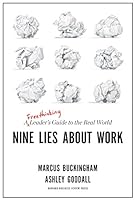
# Nine Lies About Work
**Marcus Buckingham & Ashley Goodall** | [[Action]]
---
> "If Olympic ice-skating judges can't agree on the quality of each triple toe loop, when the only thing they are doing is sitting watching triple toe loops one after the other, then what hope does a busy peer, direct report, or boss have of accurately rating your 'business acumen'?"
This demolishes most of what passes for performance management. The problem isn't that we're bad at rating people—it's that **rating people is impossible**. The data is contaminated by what psychometricians call the Idiosyncratic Rater Effect: about 60% of variance in ratings comes from the rater, not the person being rated. More raters doesn't fix this—it multiplies the error.
> "People don't need feedback. They need attention, and moreover, attention to what they do the best. Positive attention is thirty times more powerful than negative attention in creating high performance on a team."
What matters instead? **Local team experience**. Weekly check-ins. Attention to strengths. The chance to set your own goals in service of shared meaning. Buckingham and Goodall replace nine corporate myths with nine truths, all grounded in what actually predicts sustained performance: not competency models or cascaded goals, but the lived reality of teams and the frequency of attention from leaders.
---
## Core Frameworks
### [[Eight Engagement Items]]
These eight questions validly predict sustained team performance:
1. I am really enthusiastic about the mission of my company.
2. At work, I clearly understand what is expected of me.
3. In my team, I am surrounded by people who share my values.
4. I have the chance to use my strengths every day at work.
5. My teammates have my back.
6. I know I will be recognised for excellent work.
7. I have great confidence in my company's future.
8. In my work, I am always challenged to grow.
These vary more **team-to-team than company-to-company**. The team is the unit that matters. If you're in a good team at a bad company, you'll stay. In a bad team at a good company, you won't.
### [[Weekly Check-In]]
The single most powerful ritual of the world's best team leaders: **a weekly check-in with each team member**, asking two questions:
1. What are your priorities this week?
2. How can I help?
> "Frequency trumps quality. Leaders who check in every week with each team member have higher levels of engagement and performance, and lower levels of voluntary turnover."
In the intelligence business, frequency is king. Your span of control is your **span of attention**: the number of people you can check in with every week.
### [[Strengths Definition]]
A strength isn't "something you're good at." It's an activity that produces three distinct feelings: **positive anticipation** beforehand, **flow** during, and **fulfilment** afterward.
This combination is what makes an activity a strength. And the single most powerful predictor of team productivity, across industries and nationalities, is: **"I have the chance to use my strengths every day at work."**
### [[Cascading Meaning]]
> "The best companies don't cascade goals; the best companies cascade meaning."
The best companies cascade meaning—through values, rituals, and stories. **Expressed values** aren't written on walls—they're shown through what you celebrate and reward. **Rituals** are repeated actions that reinforce what matters (weekly reviews, monthly all-hands). **Stories** make meaning human and help people make sense of the world.
> "People don't want to be told what to do; they want to be told why."
---
## Key Insights
**People don't care which company they work for (once they join)—they care which team they're on.** The team experience predicts performance far more than corporate culture. Team members who trust their team leader are **12x more likely** to be fully engaged.
**The best plan rarely wins. The best intelligence wins.** Plans are generalised, quickly obsolete, and frustrating. Intelligence systems provide accurate, real-time data, distributed broadly and quickly. A year isn't a marathon planned in detail—it's **fifty-two little sprints**, each informed by the changing state of the world.
**Cascaded goals limit performance.** They slow your boat down. Goals set for you from above don't stimulate productivity—they're for **performance prediction**, not performance creation. What makes a good goal: **the person working toward it must set it voluntarily**. Any goal imposed from above is an "un-goal." We face a deficit of meaning, not a deficit of aligned action.
**Excellence is idiosyncratic.** The well-rounded high performer is a creature of theory, not reality. The best people are **spiky**—they have a few signature strengths, honed over time and put to ever greater use. Competency models are "the unmeasurable in pursuit of the irrelevant." They confuse states with traits and ignore that performance is contextual.
> "The best people are spiky, and in their lovingly honed spikiness they find their biggest contribution, their fastest growth, and, ultimately, their greatest joy."
**Excellence is not the opposite of failure.** You can't create excellent performances by only fixing poor ones. Mistake-fixing prevents failure; excellence requires replaying what works. If you see someone doing something that works, **stopping them and replaying it is your highest-priority interrupt**.
**Learning is neurogenesis: the growth of new neurons. And every brain grows most where it's already strongest.** Your strengths _are_ your development areas. Biologically, they're one and the same. The brain is "Velcro for negative experiences, Teflon for positive ones"—which is why consciously replaying success is vital.
**People can't be trained to reliably rate other people.** The Idiosyncratic Rater Effect means ratings reveal more about the rater than the person being rated. Adding more contaminated data doesn't produce accuracy—it multiplies error. **Reliable subjectivity beats unreliable objectivity.** The pursuit of objectivity in measurement is the bug, not the feature. Ask people to rate **their own experience** or intended actions, not other people's competencies.
**There's no such thing as "having potential"**—or rather, it means nothing beyond being human. What matters is **momentum**: mass (experience, capability) × velocity (energy, drive). Leaders can increase momentum by recognising and accelerating what already works.
**Leadership is someone who has followers.** The only determinant of whether anyone is leading is **whether anyone else is following**. We follow leaders who give us the **Best of We** (belonging to something bigger) _and_ the **Best of Me** (valued as unique individuals). Leadership isn't a thing (it can't be measured reliably). **Followership is a thing** (it can).
> "We follow leaders who connect us to a mission we believe in, who clarify what's expected of us, who surround us with people who define excellence the same way we do, who value us for our strengths, who show us that our teammates will always be there for us, who diligently replay our winning plays, who challenge us to keep getting better, and who give us confidence in the future."
We follow **spikes**—leaders with deep mastery in something. Spikes change how we feel about the future.
---
## Connects To
- [[Black Box Thinking]] - Matthew Syed on learning from failure complements this book's focus on learning from success
- [[Supercommunicators]] - Charles Duhigg's work on deep listening connects to the weekly check-in ritual
- [[Dead Companies Walking]] - Scott Fearon shows what happens when companies ignore team-level intelligence
- [[Playing to Win]] - Lafley & Martin on cascading strategy pairs with Buckingham & Goodall on cascading meaning
---
## Final Thought
The real value here isn't the nine lies—it's the discipline to focus on what's real and measurable. Teams, not companies. Attention, not feedback. Strengths, not deficits. Self-set goals, not cascaded targets. Your own experience, not others' ratings.
Once you understand that 60% of rating variance is rater bias, the entire edifice of performance management collapses. 360-degree feedback? Multiplied error. Competency models? Unmeasurable nonsense. Forced rankings? Systematic unfairness dressed up as rigour.
The alternative is simpler and cheaper: ask people about their own experience. "Do I have the chance to use my strengths every day?" "Are my teammates backing me?" "Am I clear on what's expected?" These are reliable, because they're self-reported. And they predict performance, because **local team experience drives engagement**.
Weekly check-ins matter more than elaborate performance conversations. Not quarterly reviews. Just two questions, every week, with every person. "What are your priorities? How can I help?" Frequency trumps quality. Your span of control is just your span of attention—the number of people you can actually check in with weekly.
**Excellence is spiky, not well-rounded.** The best performers aren't good at everything. They're exceptional at a few things and build their contribution around those strengths. Growth isn't about fixing deficits—it's about amplifying what already works. And that's biologically true: brains grow most where they're already strongest.
This is the most evidence-based management book I've read. And the evidence says: most of what organisations do to "manage performance" doesn't work. What works is attention, autonomy, meaning, and trust. The rest is theatre.