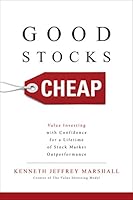
# Good Stocks Cheap
**Kenneth Jeffrey Marshall** | [[Numbers]]
---
> "I prefer to assume the worst with the prospect of delight than to assume the best with the likelihood of disappointment."
This is value investing presented as a trade—like plumbing or barbering. Useful only if it works. No mysticism, no personality cult, just method. The model has three sequential questions: Do I understand it? Is it good? Is it inexpensive? Each must be answered yes before moving to the next. If you can't understand it, there's no point checking if it's good. If it's not good, there's no point checking if it's cheap.
The emphasis on sequence matters. Price doesn't determine what to buy—only when. You first identify quality through operating performance, strategic positioning, and shareholder-friendliness. Price comes last.
> "A price is not inexpensive just because it dropped."
Value investing has at its core the fundamental belief that price and value are different. Price fluctuates; value fluctuates less. The gap between them is where returns live.
---
## Core Ideas
### [[The Understanding Statement]]
To understand a business is to describe it in a single, unambiguous sentence. Six parameters define it:
1. **Products** - Goods or services? Commodity or differentiated?
2. **Customers** - Consumers or organisations? (Customers differ from users)
3. **Industry** - What sector?
4. **Form** - Public, private, subsidiary?
5. **Geography** - Where are customers, operations, headquarters?
6. **Status** - Prominence, age, transformation, whatever merits noting
People mistake understanding one parameter for understanding all six. They assume if the products make sense, the whole business does. This false assumption—often centred on products—leads to poor decisions.
Resist the urge to complicate. Think in straight lines. An understanding statement should focus on what a business is, not what it could be.
### [[Seven Performance Metrics]]
Historic performance can be measured with seven metrics:
1. **Return on capital employed (ROCE)**
2. **Free cash flow return on capital employed (FCFROCE)**
3. **Growth in operating income per fully diluted share**
4. **Growth in free cash flow per fully diluted share**
5. **Growth in book value per fully diluted share**
6. **Growth in tangible book value per fully diluted share**
7. **Liabilities-to-equity ratio**
The first two measure how efficiently capital is deployed. The next four measure growth in value per share. The last measures financial risk.
Marshall prefers multiyear averages for normalising rather than tweaking individual years. Removing "one-time" items is dangerous: only future periods can determine what's truly irregular, management-level knowledge is required to identify them, and every year has irregularities. Once you start tweaking, there's no end.
### [[Six Sources of Moat]]
When a business does have a moat, it has a single identified source:
1. **Government** - Licenses, patents, regulations that limit competition
2. **Cost** - Structural cost advantages competitors can't replicate
3. **Brand** - Pricing power from reputation and recognition
4. **Network** - Value that increases with more users
5. **Switching costs** - Friction that keeps customers from leaving
6. **Ingrainedness** - So integral to a value chain it's hard to picture the industry without it
Most businesses don't have a moat. Accepting this saves time.
---
## Key Insights
**Capital employed is the required financial base.** Start with total assets, subtract excess cash and non-interest-bearing current liabilities. The challenge is determining what's "excess" cash. One approach: calculate two versions—one with all cash subtracted, one with none. Great opportunities shine through regardless.
**Capitalise operating leases.** If accounting sees an operating lease but you smell a capital lease, adjust. Many operating leases mask the full scope of liabilities. It's tedious work, but the skill is worth mastering.
**Levered free cash flow gives a different view than operating income.** Operating income is accrual-based, ignores taxes and interest. Levered free cash flow is cash-based, captures both. Marshall likes having both perspectives—they illuminate different aspects of the same business.
**The prettier the page, the less useful it is.** Skip bar charts, CEO letters, and world maps. The meat of an annual report begins with consolidated financial statements. Quarterly reports are less useful because they're unaudited and the fourth quarter often mops up estimates from prior quarters.
**Valuation has few metrics that matter.** MCAP/FCF no higher than 8. EV/OI no higher than 7. MCAP/BV and MCAP/TBV no higher than 3. These are qualifiers, not targets. Low price multiples signal opportunity when they reflect unjustifiably high discount rates.
> "Great buys have a way of shining through all kinds of assumptions."
**Buying inexpensively both increases return and lowers risk.** This inverts the standard finance claim that higher returns require higher risk. By buying the same number of shares at a lower price, you're starting closer to the goal. Volatility and risk are different things.
**Eighteen cognitive biases cause investor misjudgment.** Among them: anchoring, confirmation, lossophobia (fear of losses), hotness (chasing recent performance), and windfallapathy (treating gains as less real than principal). Knowing the list doesn't make you immune, but it helps.
**Promising idea sources.** Bad news, spin-offs, regulatory filings, reorganisations, small-caps, stock screeners, and serendipity. The last requires mental preparedness to receive tips from everyday life. It favours the open mind.
**The checklist is a survival tool.** It's not a shopping list of desirable attributes ("Is this company cheap?"). It's designed to avoid mistakes that have previously led to crashes—a haunting remembrance of things past. Your checklist must reflect your own experience and previous mistakes.
---
## Connects To
- [[How Finance Works]] - provides conceptual grounding; this book provides practical method
- [[The Most Important Thing]] - both emphasise buying well over buying good things
- [[Investing for the Long Term]] - complementary approaches to value investing
- [[Richer, Wiser, Happier]] - Marshall's method would appeal to the investors profiled there
- [[Superforecasting]] - the emphasis on process over outcome echoes Tetlock
---
## Final Thought
Value investing is simple but not easy. The three questions—do I understand it? is it good? is it inexpensive?—can be stated in seconds but take years to answer well. Each involves judgment, and judgment develops only through practice.
The margin of safety is the space you allow yourself to be wrong. Buying inexpensively creates that margin. But the deeper margin comes from process: reading financial statements until the unexpected dissolves into readiness, building a checklist that encodes your own mistakes, knowing your cognitive biases even if you can't fully overcome them.
> "Money just doesn't produce life's great joys. Those come from loved ones, from health, and from other sources that don't care much about geometric means, depreciation schedules, or enterprise values. But an absence of money can keep one from the great joys. And therein lies value investing's promise."
The goal isn't wealth for its own sake. It's the freedom to fully embrace what matters—to drop everything and lavish attention on such gifts, fearlessly, at times of your choosing. That's what rich is.