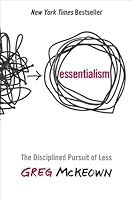
# Essentialism
**Greg McKeown** | [[Action]]
---
> "If you don't prioritise your life, someone else will."
We live in a world where almost everything is worthless and a very few things are exceptionally valuable. The Essentialist's job is to discern the vital few from the trivial many—then eliminate everything else. Not less for the sake of less, but the disciplined pursuit of the right things.
The core reframe: Essentialism isn't about how to get more things done. It's about how to get the right things done.
---
## Core Ideas
### [[The Disciplined Pursuit of Less]]
The way of the Essentialist rejects the idea that we can fit it all in. It requires grappling with real trade-offs and making tough decisions. The goal is to make one-time decisions that eliminate a thousand future decisions—living by design, not by default.
One paradox: Essentialists actually explore more options than non-Essentialists. They spend time listening, debating, questioning, and thinking. But the exploration has a purpose—to discern what's essential, then ruthlessly cut everything else.
The highest priority is to protect your ability to prioritise.
### [[The Reverse Pilot]]
When something isn't working, we usually think in terms of addition: what can we add to fix it? The Essentialist thinks in terms of subtraction: what can we remove?
A reverse pilot tests whether removing an initiative or activity has any negative consequences. Quietly eliminate or scale back something for a few days or weeks. If no one notices, it wasn't essential. This works in social commitments too—are there things you've assumed matter to others that they'd barely register if you stopped?
The Latin root of "decision" (*cis* or *cid*) means "to cut" or "to kill." If there's no cutting, you haven't made a decision.
### [[Routine as Liberation]]
There's a huge body of research showing how routine makes difficult things easy. The right routines don't constrain creativity—they enable it by giving you an energy rebate. Instead of spending limited discipline on the same decisions repeatedly, embedding decisions into routine frees discipline for essential activities.
Every habit has a cue, routine, and reward. To change a routine, you don't need to change the behaviour directly. Find the cue triggering the non-essential behaviour and associate it with something essential instead.
---
## Key Insights
**The best asset you have for making a contribution is yourself.** If you underinvest in your mind, body, and spirit, you damage the very tool you need for your highest contribution. Sleep deprivation is how ambitious, successful people most commonly damage this asset.
**Essentialists choose "no" more often than they say no.** Saying no requires trading popularity for respect. A clear no is more graceful than a vague or noncommittal yes. Useful responses: the awkward pause, "let me check my calendar," "yes—what should I deprioritise?", or simply "you're welcome to X, I'm willing to Y."
> "No is a complete sentence." — Anne Lamott
**Don't rob people of their problems.** When colleagues try to use your sprinklers to water their own grass—pulling you into committees, asking for input on work they haven't refined, talking your ear off when you have priorities—the solution is boundaries set well in advance. Forcing people to solve their own problems benefits both of you.
**The endowment effect distorts what you keep.** We overvalue what we own simply because we own it. Students who "owned" mugs valued them at $5.25; students without them would pay only $2.75. This is why we hold onto commitments, projects, and relationships longer than we should. Admit failure to begin success.
> "The best surgeon is not the one who makes the most incisions; similarly, the best editors can sometimes be the least intrusive, the most restrained."
**The slowest hiker sets the pace.** If you want to improve system performance, identify the constraint—the slowest hiker in the group. It's easier to think about execution as addition (more salespeople, more production), but the Essentialist focuses on removing obstacles.
**Progress is the most effective motivator.** A small, concrete win creates momentum and affirms faith in further success. "Of all the things that can boost emotions, motivation, and perceptions during a workday, the single most important is making progress in meaningful work."
**If you don't set boundaries, there won't be any.** Or worse—there will be boundaries, but set by default or by someone else. When you have clear boundaries, you're free to explore the whole range of options within the space you've deliberately chosen.
---
## Connects To
- [[Via Negativa]] - improving by subtraction rather than addition
- [[The Haystack Syndrome]] - the constraint is the system; Essentialism applied to operations
- [[Theory of Constraints]] - the "slowest hiker" metaphor; focusing on what limits throughput
- [[Nine Lies About Work]] - both books reject the myth of work-life balance through volume
- [[Loss Aversion]] - the endowment effect and sunk-cost bias make cutting painful
- [[Lean Business Planning]] - planning as ruthless prioritisation, not comprehensive documentation
- [[Optionality]] - saying no to almost everything to preserve capacity for the vital few
---
## Final Thought
There are two ways to think about Essentialism: as something you do occasionally, or as something you are. The occasional application gives you a productivity boost. The identity shift changes how you move through the world.
Without courage, the disciplined pursuit of less is just lip service—dinner party conversation, skin deep. Anyone can talk about focusing on what matters most. Seeing people who actually live it is rare.