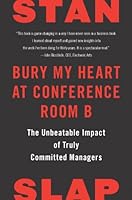
# Bury My Heart at Conference Room B
**Stan Slap** | [[Action]]
---
> "A manager's emotional commitment is the ultimate trigger for their discretionary effort, worth more than financial, intellectual and physical commitment combined."
You can pay managers more, give them better tools, promote them faster—and none of it will sustainably move performance. **External rewards are neurobiologically irrelevant to motivation.** The only thing that unlocks discretionary effort is the ability to live your deepest personal values at work.
Stan Slap's argument is uncomfortable: as a manager, your most important responsibility is to your company. As a leader, your most important responsibility is to yourself. You must fulfil your personal responsibility first. Far from being subversive, this is the single most supportive corporate action you can take.
The operational reframe: leadership isn't about charisma or strategy or intelligence. It's about living your deepest personal values without compromise, and using those values to make life better for others. Leaders change the world around them in the name of their values, so they can live those values more fully. That's why people become leaders and why people follow them.
---
## Core Ideas
### [[Emotional Commitment]]
Emotional commitment means unchecked, unvarnished devotion to the company and its success. Every legendary organisational performance is the result of emotionally committed managers.
There are four types of commitment: financial (pay me enough and I'll show up), intellectual (interesting work keeps my brain engaged), physical (I'll put in the hours), and emotional (I care deeply because this work lets me live my values).
The first three hit a ceiling. Only emotional commitment triggers discretionary effort. The neurobiological source is straightforward: the ability to live your own deepest values in a relationship or environment. As a manager, this means your relationship with your company and your environment at work.
Bottom line: you must live your personal values at work. There is no sustainable workaround.
### [[Values vs Morals]]
The transformation of values into fence-building and social weaponry happens when they're confused with morals.
**Morals** are how a person ought to act in the opinion of authority, consensus, or society's rules—the "right thing to do." **Values** are the right thing *for you* to do. They're deeply held personal beliefs that form your own priority code for living. Your individual biases for deciding which actions are true for you alone. Your source of safety, hope, and renewal.
Your values may sometimes align with your morals, but they don't have to. You might think it's morally wrong to steal, but if it isn't something you care about obsessively and that drives your daily decision-making, it isn't a value.
Leadership isn't based on the literal definition of your values—it's based on the **transferable currency**. Family doesn't mean time spent with family; it means open, honest communication and unconditional support. That's what family time gives you that makes it so important.
### [[Leadership as Living Values]]
> "The irreducible essence of leadership is that leaders are people who live their deepest personal values without compromise, and they use those values to make life better for others."
The purpose of leadership is to change the world around you in the name of your values, so you can live those values more fully. The process of leadership is to turn your values into a compelling cause for others, so you gain resources to help you do that.
Leaders begin with acute awareness of what's most important to them and a deep desire to remake the world around them so they can more fully experience it. Being a leader means being able to sell your values to others. Getting people to support what you believe in most is the great triumph of leadership. Getting *you* to support what you believe in most is the great leap of faith.
### [[Three Levels of Responsibility]]
As a human being, you're responsible for yourself. As a manager, you're also responsible for others. As a member of management, you're furthermore responsible for your company and all who depend on its success.
The paradox: to safely trust managers, a company must allow them to do the things that real leaders do for the reasons that real leaders do them. Your company won't naturally align itself with your deepest personal values. You have to align with your own values and then make them work within the company.
Good news: it's not your fault. Bad news: it's your responsibility.
---
## Key Insights
**Management controls performance because it impacts skill**—monitoring, analysing, directing. **Leadership creates performance because it impacts willingness**—modelling, inspiring, reinforcing. It's not what leaders do that's important; it's why they do it. Leadership is a motivation, a purpose before it's ever a practice. The worst thing in your development as a leader is not to do it wrong—it's to do it for the wrong reasons.
**One of the biggest myths: leadership is a burden.** If it were a burden, nobody would do it. Leadership is a benefit—a series of profound personal benefits you can get only by doing what leaders do. You're going to love the benefits of leadership.
**A leader knows exactly who they are and exactly where they want to go.** What separates a leader from a normal human being? They're acutely aware of what moves them. A leader has such self-awareness they could confidently name their most important values—and they know *why* those values matter.
> "Let the walls come down. Don't lead from your head. Lead from what you believe in."
**Leaders are fabulous communicators.** Every chance to communicate is another chance to sell or resell their leadership vision. They create the highest level of trust—they do exactly what they say they're going to do. They make a lot of mistakes, and they admit those mistakes to themselves and to their people, changing because of them.
**In leader-speak, the Better Place is called "vision."** Because their vision is driven by true belief, leaders really can see that Better Place. They create vivid descriptions of it—they have to describe it so you can really see it. Why? Because no one else really can see it. It isn't here yet. It won't be real until people help the leader make it real. Your vision does have to be somewhat grounded in reality; it's only inspirational on a sustained basis if people believe it can be achieved.
**The key to work/life balance is not escaping work but being who you really are at work.** To do that, it helps to be who you really are at home. Don't be concerned about whether your employees have different values. They'll still support yours if yours have positive impact for them.
---
## Connects To
- [[The Truth About Employee Engagement]] - Both emphasise that engagement comes from meaningful work aligned with personal values, not external rewards
- [[Nine Lies About Work]] - Aligns with the idea that people don't work for the company—they work for meaning and the chance to contribute
- [[The Courage to Be Disliked]] - Living your values without compromise means having the courage to be disliked; refusing to live for others' expectations
- [[Ego Is The Enemy]] - Leadership driven by values (not ego) creates authentic followership rather than performance theatre
- [[Playing to Win]] - Vision equals the Better Place; leaders must be able to articulate where they're going and why it matters
---
## Final Thought
You cannot sustainably motivate managers with external rewards. Pay, perks, promotions—they're neurobiologically irrelevant. The only thing that unlocks discretionary effort is the ability to live your deepest personal values at work.
The reframe of responsibility: as a manager, your most important responsibility is to your company. As a leader, your most important responsibility is to yourself. You must align with your own values first. This feels subversive—like you're putting yourself before the company. But it's the opposite. The only way to sustainably serve the company is to lead from your values, not from your head.
Leadership is not a burden—it's a benefit. Leaders don't sacrifice themselves for others; they change the world around them so they can live their values more fully. That's why people become leaders and why people follow leaders. Not charisma. Not strategy. Values.
Stop performing leadership and start living it. Figure out your deepest values, turn them into a compelling Better Place, and sell that vision to others. If your work doesn't let you live your values, you'll never unlock emotional commitment—yours or anyone else's.