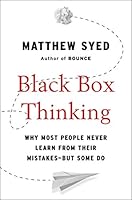
# Black Box Thinking
**Matthew Syed** | [[Action]]
---
> "Science is not just about a method; it is also about a mindset. At its best, it is driven forward by a restless spirit, an intellectual courage, a willingness to face up to failures and to be honest about key data, even when it undermines cherished beliefs."
Most organisations treat failure as something to hide. Aviation treats it as something to study. The difference in mindset creates radically different outcomes. Black box thinking is about building systems that guide learning and self-correction—but systems alone aren't enough. You need professionals willing to share information that enables the system to flourish.
> "Sometimes, committing errors is not just the fastest way to the correct answer; it's the only way."
We're hardwired to think the world is simpler than it is, but progress requires testing things that violate our beliefs. Without mistakes, we get stuck in narrow hypotheses. Fewer than 10% of college students discovered the pattern in the 2-4-6 experiment. Most people get stuck in narrow, wrong hypotheses. The only way out is to make a "mistake" that turns out not to be a mistake.
Creativity is not an act of genius—it's a response to failure. Innovation has nothing to latch onto without a problem, a flaw, a frustration. And winners aren't pioneers; they're the ones who combine creative intensity with relentless discipline.
---
## Core Ideas
### [[Black Box Thinking]]
The core principle: every failure is an opportunity for learning if the system is designed to capture it.
Aviation investigates every crash rigorously and shares data openly across the industry. Lessons lead to systemic improvements. Failures are "red flags" that can't be ignored or reframed.
Most industries treat failures as ambiguous events that can be given a makeover. Justifications multiply: "it was a one-off," "we did everything we could." Cognitive dissonance prevents learning even when incentives favour it. The problem isn't just external incentives; it's the internal difficulty of admitting mistakes.
When a plane crashes, it's difficult to pretend the system worked. The failure is stark—a "red flag." Most failure can be given a makeover. You can selectively cite statistics that justify your case whilst ignoring those that don't. Ambiguity is the enemy of learning.
### [[Marginal Gains]]
Marginal gains isn't about making small changes and hoping they work. It's about breaking down big problems into small parts to rigorously establish what works, isolating effects through controlled experimentation, and improving the data set before improving the final function—understanding what you didn't initially understand.
Marginal gains is inherently about empirical testing, not guesswork. Controlled experimentation is inherently 'marginal' in character. This is marginal gains on turbocharge: you improve your understanding through disciplined testing, not through wishful thinking.
### [[Creativity as Response]]
> "Creativity should be thought of as a dialogue. You have to have a problem before you can have the game-changing riposte." — James Dyson
Creativity isn't something that happens to geniuses through contemplation. It's a response to failure, a flaw, a frustration. Without a problem, innovation has nothing to pivot on. The idea that creative insights emerge from the ether through pure contemplation is wrong. Creativity is something that has to be worked at, and it has specific characteristics.
Epiphanies happen in two environments: when switching off (shower, walk, daydream)—the associative state emerges—and when sparked by the dissent of others. When we're too focused, when we're thinking too literally, we can't spot the obscure associations that are so important to creativity.
### [[Innovation + Discipline]]
Research on 66 commercial sectors found that only 9% of pioneers ended up as winners, whilst 64% of pioneers failed outright.
What characterised winners who made ideas work? One word: **discipline**. Not just the discipline to iterate a creative idea into rigorous solution, but also the discipline to perfect manufacturing, supply lines, delivery.
> "When you marry operating excellence with innovation, you multiply the value of your creativity." — Jim Collins
Winners require both creative intensity and relentless discipline. The great task, rarely achieved, is to blend creative intensity with relentless discipline so as to amplify the creativity rather than destroy it.
---
## Key Insights
**When we are confronted with evidence that challenges our deeply held beliefs, we are more likely to reframe the evidence than alter our beliefs.** We invent new reasons, new justifications, new explanations. Sometimes we ignore evidence altogether. The problem is not just the external incentive structure; it's the internal one. It's the sheer difficulty we have in admitting mistakes even when we're incentivised to do so.
**There's a subtle asymmetry between confirmation and falsification, between success and failure.** Confirmation is easy; falsification is hard. Success can be reinterpreted endlessly, but plane crashes force honesty. Red flags are failures too stark to ignore or reframe. Most organisations don't have enough red flags—their failures are ambiguous enough to justify away.
**"If I want to be a great musician, I must first play a lot of bad music."** Same for tennis, architecture, any field requiring mastery. Creativity is worked at, not waited for. It has specific characteristics and requires understanding the process. The model that conceives of innovation as something that happens to people, normally geniuses, could not be more wrong.
**Grit is strongly related to Growth Mindset.** It's about how we conceptualise success and failure. If we interpret difficulties as indictments of who we are, we run from failure. If we see them as pathways to progress, we persevere. The mistaken idea that success is instant destroys resilience.
**Growth Mindset isn't wishy-washy.** It's not a happy-clappy, we-are-all-winners approach. It's a cutting-edge approach based upon the most basic scientific principle of all: we progress fastest when we face up to failure and learn from it. Paradoxically, people with Growth Mindset are MORE capable of making rational decisions to quit (they're not defending their ego).
**The question often asked in the aftermath of an adverse event, "can we afford the time to investigate failure?", seems the wrong way round.** The real question is "can we afford not to?" Each system has mechanisms that guide learning and self-correction. But an enlightened system on its own is sometimes not enough. Even the most beautifully constructed system will not work if professionals don't share the information that enables it to flourish.
---
## Connects To
- [[Algorithms to Live By]] - Process over outcome; even the best strategy sometimes yields bad results
- [[The Fifth Discipline]] - Learning organisations require systems for self-correction and shared information
- [[7 Powers]] - Process Power requires discipline; innovation alone isn't enough
- [[Better, Simpler Strategy]] - Testing what raises WTP/WTS requires marginal gains approach
- [[High Performance Habits]] - Growth mindset and grit enable sustained performance
- [[Antifragile]] - Learning from errors is how systems become antifragile
---
## Final Thought
The aviation industry's success isn't about having better people—it's about having better systems for learning from mistakes. But systems alone aren't enough; you need a culture where professionals share uncomfortable truths instead of protecting egos.
The hardest lesson: cognitive dissonance is internal, not just external. Even when incentivised to admit mistakes, we struggle because our beliefs are part of our identity. The solution isn't better incentives—it's building systems that make failures impossible to ignore (red flags, not ambiguous setbacks) and cultures that celebrate learning over looking good.
Creativity requires failure to respond to. Pioneers fail because they have ideas without discipline. Winners succeed by combining creative intensity with relentless execution. Innovation alone is vanity; innovation plus marginal gains is transformation.
Mistakes aren't just acceptable—they're necessary. If you're not making mistakes, you're not testing things that violate your beliefs. And if you're not testing things that violate your beliefs, you're stuck in a narrow hypothesis about how the world works. Sometimes, committing errors is not just the fastest way to the correct answer; it's the only way.