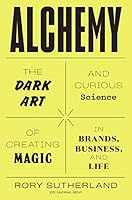
# Alchemy
**Rory Sutherland** | [[Prediction]]
---
> "The human mind does not run on logic any more than a horse runs on petrol."
We've over-applied logic from physics to human affairs. The economy isn't a machine—it's a complex adaptive system. Machines don't allow for magic; complex systems do.
> "We don't value things; we value their meaning. What they are is determined by the laws of physics, but what they mean is determined by the laws of psychology."
You can create or destroy value in two ways: by changing the thing, or by changing minds about what it is. Perception creates reality in human systems.
> "There are often two reasons behind people's behaviour: the ostensibly logical reason, and the real reason."
Market research is fatally flawed because people don't think what they feel, don't say what they think, and don't do what they say.
If we allow the world to be run by logical people, we will only discover logical things. But in real life, most things aren't logical—they're **psycho-logical**. The opposite of a good idea can also be a good idea. Test counterintuitive things, because no one else will.
---
## Core Ideas
### [[Rory's Rules of Alchemy]]
The opposite of a good idea can also be a good idea. Whilst in physics the opposite of a good idea is generally bad, in psychology opposites often both work.
> "While in physics the opposite of a good idea is generally a bad idea, in psychology the opposite of a good idea can be a very good idea indeed: both opposites often work."
Don't design for average—metrics encourage you to focus on the middle, but innovation happens at the extremes. It doesn't pay to be logical if everyone else is being logical. Competitive advantage lies in the irrational. Test counterintuitive things, only because no one else will. If there were a logical answer, we would have found it.
### [[Logic vs Psychology]]
Being "too logical" is dangerous. Highly educated people use logic as part of their identity, leading to logical overreach. In theory, you can't be too logical. In practice, you can.
Context is king. Logical ideas fail because logic demands universally applicable laws, but humans aren't consistent enough for such laws to hold broadly. Evolution is like a brilliant uneducated craftsman: what it lacks in intellect it makes up for in experience. Not everything that makes sense works, and not everything that works makes sense.
Two separate forms of scientific enquiry exist: the discovery of what works, and the explanation of why it works. These are entirely different things and can happen in either order. Perhaps a plausible "why" should not be a prerequisite in deciding a "what."
### [[Psycho-Logic]]
Behaviour doesn't follow "rational" logic for good reasons. Instincts are heritable; reasons have to be taught. What matters is how you behave, not knowing why. Evolution attaches emotions to behaviours as a way to encourage or prevent them. We experience emotions for a reason—often a good reason for which we don't have the words.
"You're being emotional" is used as code for "you're being an idiot," but emotions are evolutionarily functional. In trying to encourage rational behaviour, don't confine yourself to rational arguments.
---
## Key Insights
**The strongest marketing approach in business-to-business comes not from explaining that your product is good, but from sowing fear, uncertainty and doubt (FUD) around the available alternatives.** People aren't trying to make the best decision—they're trying not to get blamed or fired. Randomness in decisions creates strategic advantage. If you're wholly predictable, people learn to hack you.
Metrics and averages encourage focus on conformity, but with multiple hires you want complementarity, not ten versions of the same person.
**Certainty beats superiority in brand preference.** People choose Brand A not because they think it's better, but because they're more certain it's good. Heuristics aren't second-best; in a world where satisficing is necessary, they're often the easiest and best option.
> "The nature of our attention affects the nature of our experience."
**Behaviour comes first; attitude changes to keep up.** Give people a behaviour and they'll supply the reasons themselves. The lesson from the appendix: something can be valuable without necessarily being valuable all the time. Irrational people are more powerful than rational people because their threats are more convincing.
> "Think of life as like a criminal investigation: a beautifully linear and logical narrative when viewed in retrospect, but a fiendishly random, messy and wasteful process when experienced in real time."
**Long-term self-interest often leads to behaviours that are indistinguishable from mutually beneficial cooperation.** Two contrasting approaches exist: "tourist restaurant" (maximise money per visit) versus "local pub" (make less per visit, profit more over time from loyalty). Reciprocation, reputation, and pre-commitment signalling are the three big mechanisms that underpin trust.
> "Unlike short-term expediency, long-term self-interest, as the evolutionary biologist Robert Trivers has shown, often leads to behaviours that are indistinguishable from mutually beneficial cooperation."
**All powerful messages must contain an element of absurdity, illogicality, costliness, disproportion, inefficiency, scarcity, difficulty or extravagance—because rational behaviour and talk, for all their strengths, convey no meaning.** Costly signalling matters: the meaning derives from consumption of some costly resource (money, talent, effort, time, skill, humour, bravery). It's only by deviating from narrow, short-term self-interest that we can generate anything more than cheap talk.
Economists hate advertising and barely understand it; biologists understand it perfectly.
**The fact that something does not work through a known and logical mechanism should not make us unwilling to adopt it.** We used aspirin to reduce pain for a century without having the faintest idea of why it worked. In the words of Jonathan Haidt: "The conscious mind thinks it's the Oval Office, when in reality it's the press office." We're engaged in hastily constructing post-rationalisations for decisions taken elsewhere.
At some point we must ask: do these things work despite being illogical, or because they are? Much luxury goods expenditure can only be explained as mood-altering substance—people seeking to impress each other or themselves.
**The trouble with market research is that people don't think what they feel, they don't say what they think, and they don't do what they say.** For a business to be truly customer-focused, it needs to ignore what people say and concentrate on what people feel. People may be accurate commentators on their emotional state, but the causes of that emotional state are often a complete mystery to them.
Advertising agencies are valuable partly because they create a culture where it's acceptable to ask daft questions and make foolish suggestions.
---
## Connects To
- [[7 Powers]] - Counter-Positioning often looks "illogical" (violates conventional wisdom)
- [[Better, Simpler Strategy]] - Challenges the idea that WTP/WTS is always rationally calculated; perception shapes both
- [[Algorithms to Live By]] - Challenges pure algorithmic thinking; human systems require psychological understanding, not just computational logic
- [[The Fifth Discipline]] - Complex adaptive systems (not machines) require different thinking
- [[Everything Is Predictable]] - Contradicts; Bayesian reasoning assumes some rationality, but Alchemy shows humans are systematically "irrational"
- [[Dead Companies Walking]] - Companies fail when they mistake customer "logic" for actual behaviour
---
## Final Thought
Sutherland's core argument—that human behaviour is psycho-logical, not logical—is the antidote to MBA-think, to spreadsheet determinism, to the tyranny of metrics. It liberates you to test "silly" ideas that happen to work.
The frame: **if everyone else is being logical, competitive advantage lies in being irrational**. This explains why advertising agencies succeed, why placebos work, why the IKEA effect exists, why costly signalling matters. It's not that logic is useless—it's that logic alone is insufficient for understanding systems made of humans.
Most importantly: **behaviour precedes attitude**. Give people a behaviour and they'll invent the reasons themselves. This inverts conventional change management (which tries to change attitudes first) and opens up an entirely different playbook for influence. Change the behaviour, the beliefs will follow.
The book is messy, digressive, and occasionally contradictory—which is perfect, because that's how human systems actually work.